
seven path seed labyrinth
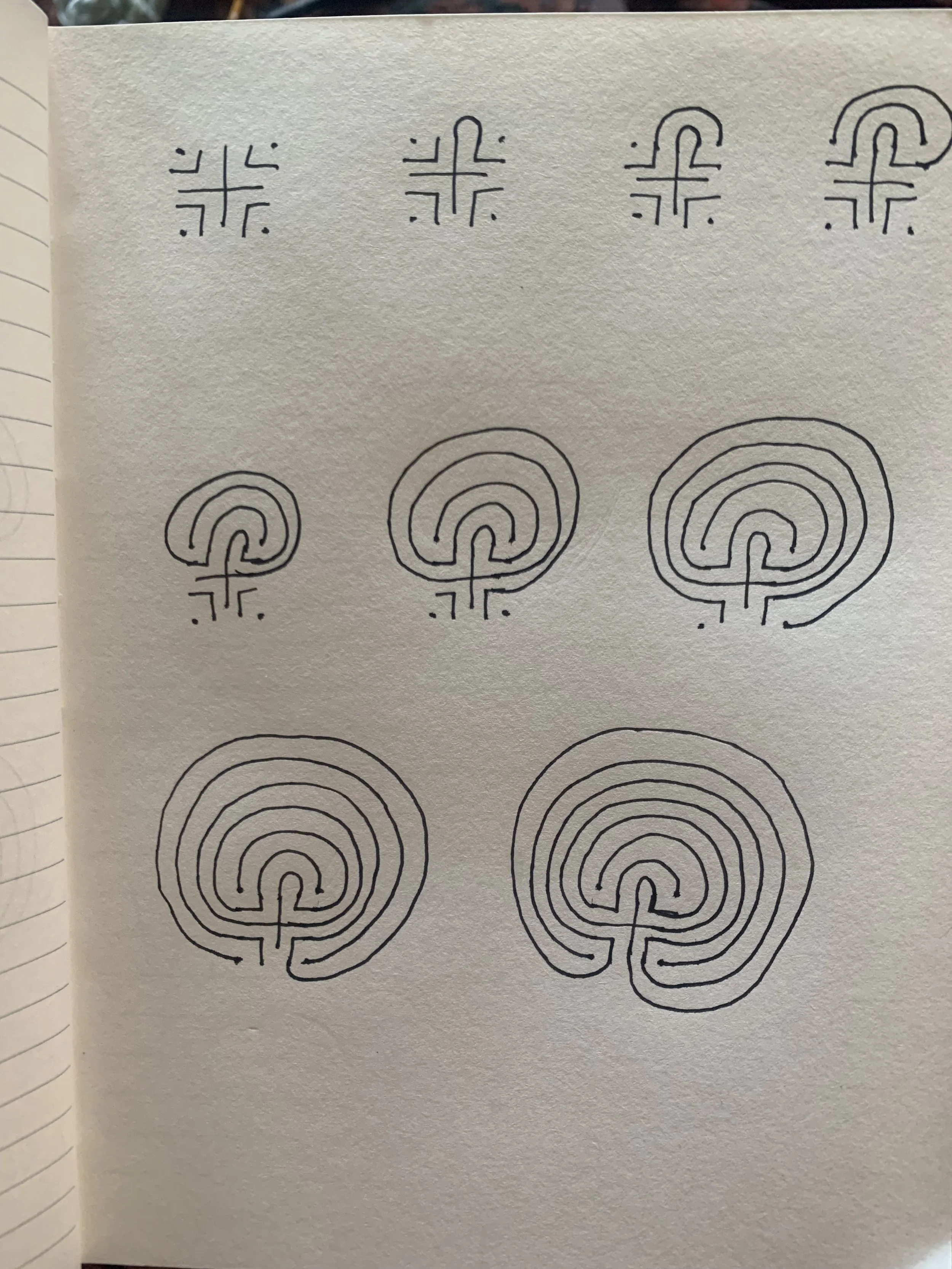
Starting with a cross, right angle and dot
The seed labyrinth is the most ancient of shapes. It can be drawn by following the steps above.
Some of the oldest datable forms of a labyrinth are found in Southern Europe, around 4,000 years old. They are all based around the classic seven concentric pathways, carefully connected and leading to the centre. They’ve been found scratched or painted on fragments of pottery, carved onto walls. There is a labyrinth incised on the inner wall of a chamber in Neolithic Domos de Janas underground tomb of Luzzanas, on the island of Sardinia, that claims to be from around 2500BCE. (Jeff Saward, labyrinthos.net)
There’s also fragments found from around the same age from Tell Rifa’at, Syria, the Hollywood Stone from County Wicklow, Ireland, and the Rocky Valley labyrinth carvings in Cornwall, England. There are labyrinth petroglyphs in Spain, Italy, and Scandinavia, and other places. Later on the labyrinth became popular with the Roman’s who would have brought a resurgence wherever they went. The labyrinth design becoming more elaborate and found in mosaics and pottery.
This ancient seed labyrinth is the kind of doodle that children can do, it’s one that can be done on a beach. It feels so primordial, so very basic and yet, one slight mistake and the mind can play tricks as you draw it, one little error causing confusion. I often find the most simple things can be the most profound.